Ford Model T FAQs – Frequently Asked Questions
WHAT ARE THE BEST BOOKS FOR FORD MODEL T OWNERS?
There are three books that every Ford Model T owner should have. The first is the Ford Model T Owner’s Manual. (Reproductions are available at a very reasonable cost) This book provides answers 140 questions, broken down into the same categories this page uses. The second important book is the Ford Model T Service Manual, which takes the owner’s manual as its start point but goes into more detail about making repairs. The third is the “Complete Ford Model T Guide” which provides even more detailed information about setting up your T to work well and look good doing it
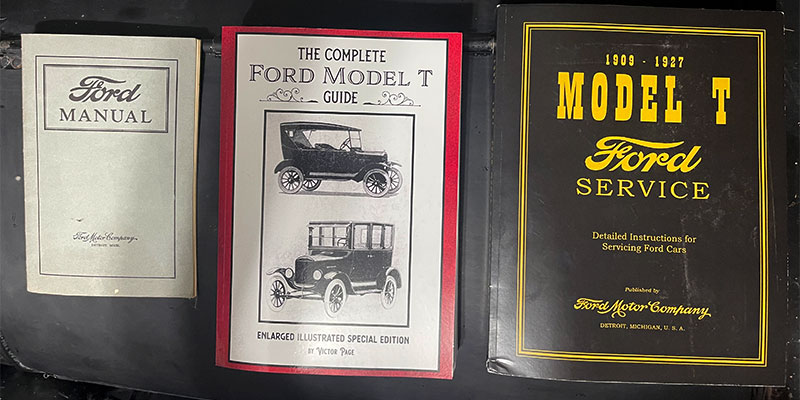
Ford Model T Owners and Service Manuals
WHAT OIL SHOULD BE USED IN A FORD MODEL T?
Model Ts came from the factory with the equivalent of SAE 20 weight. The nearest regularly available modern oil is 30W ND (non-detergent.) But modern oils are superior in every way to what they had back in the T era. Many people, especially in cold climates, use multi-weight oils, such as 10-30 or 15-40. You really can’t go wrong.
WHAT TYPE OF FUEL SHOULD BE USED IN A FORD MODEL T?
If you drive your T frequently, anything you can get from a regular gas station is fine. You don’t need to overthink this. Just fill up and go, like a modern car. People who don’t drive their Ts very much should avoid ethanol blends as the ethanol absorbs moisture from the air over time. People who put their cars away for the winter should either completely empty the gas tank or fill it to the very top (to minimize the amount of air in the tank) and use a long-term fuel stabilizer.
WHAT COOLANT SHOULD BE USED SHOULD BE USED IN A FORD MODEL T?
Any 50/50 antifreeze mix is just fine for virtually all circumstances. It helps to inhibit rust. For very heavy duty work, such as parades, you can use distilled water, as it dissipates heat a little better. A “Water-Wetter” additive to help prevent internal corrosion is advisable, but it starts getting back into 50/50 heat exchange territory. If push comes to shove, you can use distilled water but be sure to add straight antifreeze as soon as possible. Never use straight tap water. It is full of contaminants, especially lime. If you simply have no choice, flush the radiator and block as soon as possible to get rid of contaminants before they cause serious damage.
WHERE IS THE VIN LOCATED ON A FORD MODEL T?
The number used as the VIN – vehicle identification number – on Model Ts is the engine number, which is stamped on the block just above the coolant inlet on the driver’s side in the USA. (The number is stamped in other locations on the very earliest Ts.) In 1926 many – but not all – Ts had this number stamped on the side rail close to the parking brake. Otherwise the T has no identifying numbers. Stamping numbers on parts and components – the famous matching numbers issue – simply does not exist on Model Ts.
IS THE FORD MODEL T NEGATIVE OR POSITIVE GROUND
Ford Model Ts are negative ground.
IS THE FORD MODEL T 6 OR 12 VOLTS?
All Ts came from the factory with a six volt system. Many people run their Ts at twelve volts, mainly to improve the brightness of the headlights and for easier starting.
HOW FAST DOES A FORD MODEL T GO?
Factory specification Model Ts go down level roads most happily between 35 – 40 MPH. With such low power, they will be significantly affected by road conditions, the number of passengers, hills, and weather.
WHAT IS THE MPG IN A FORD MODEL T?
Ts on average achieve around Twenty Miles Per Gallon, 20 MPG, but this will be affected by driving conditions, the terrain, the number of passengers, and the enthusiasm of the driver.
WHY DO SOME MODEL TS IN THE USA NOT HAVE A DOOR FOR THE DRIVER?
The short answer is that the location of the parking brake on the driver’s left side on left hand drive vehicles made getting in and out on that side very difficult. As mass production ramped up, to save time, money and effort, the front door for the driver’s side was deleted. This made five-seat touring cars three-door vehicles, and two-door open cars – called runabouts – one-door cars.
Longer answer. For the first few years, almost all Model Ts were open cars – think convertible – and did not have doors at all. Then half doors were introduced for rear seat passengers only. Finally front seat occupants got some protection from dust and mud as well. The exception was the town car, but even these did not have door at the front to begin with. In 1915 a fully enclosed sedan was introduced but it only had two doors, located in the center of the body, so neither front nor rear. It was not until the all black era that fully enclosed two and four-door enclosed sedans got a door for the driver. The open cars continued without one until 1926.
Ford Model T made in Canada do have a door for the driver. Because so many Ts made in Canada were exported to the UK and other parts of the British Empire, where they drive on the left side of the road and the driver sits on the right, they made all their Ts with driver’s door to keep production simple.
DID THE FORD MODEL T COME WITH A TOOL KIT?
Yes, and a jack a well.
DID THE FORD MODEL T COME WITH A SPARE TIRE?
Yes. During the brass era, people would carry them to the running boards. In the all black era, cars came with a carrying device on the back of the car. After demountable rims were introduced, owners got a spare rim as well.
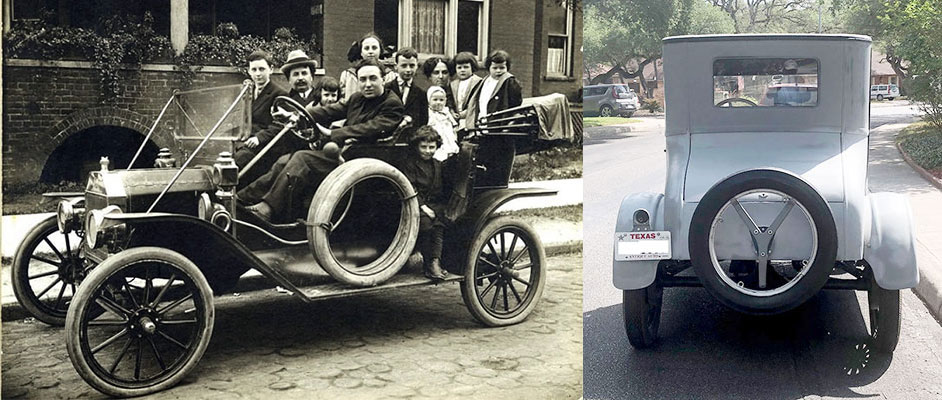
Ford Model T spare tire carriers
DID THE FORD MODEL T HAVE FACTORY INSTALLED SPEEDOMETERS?
No. All speedometers and odometers on Model Ts were after-market accessories.
DID THE FORD MODEL T HAVE A FACTORY INSTALLED ENGINE TEMPERATURE GAUGE?
No. All temperature gauges on Model Ts were after-market items. The ‘motometer’ that attached to the filler neck were the most popular type. Ford allowed their logo to be used on these, probably for a small fee. Other types with a sensor on the engine were also available.
DID THE FORD MODEL T HAVE FACTORY INSTALLED WINDSHIELD WIPERS?
Mostly, no. In the USA, the first windshield wipers installed at the factory were installed only on closed cars after 1924. Prior to this, they were an after-market accessory. Most were hand operated. Vacuum powered wipers were available as an after-market accessory.
DID THE FORD MODEL T HAVE FACTORY INSTALLED HEATERS AND WINDOW DEFROST?
No. There were a variety of after-market options, some taking heat from the engine, others from charcoal burning inside a carpeted container. It’s worth noting that the transmission hogshead is immediately under the thin wooden floor boards and the feet of the driver and front passenger were mere inches away from it.
DID ALL FORD MODEL Ts HAVE COWL LIGHTS?
Most Ford Model Ts had cowl lights until battery powered lights became available in 1919. They were still installed on Ts purchased without a battery and starter. These cowl lights are oil (kerosene) lamps. They served two purposes. They made the cars more visible at night on unlit streets. Many jurisdictions mandated that they be lit at night. People during the T era were familiar with kerosene lamps as this is what illuminated their houses. The kerosene was less trouble and less expensive than burning acetylene lamps, and less draining on batteries once they were installed. The other reason was during the era of acetylene gas and magneto powered head and tail lights, these would dim to next to nothing when the engine was going slow. The oil marker lamps added to the vehicle’s visibility at stop signs or traffic jams. Factory marker lamps were discontinued after the installation of batteries in 1919 except on Ts sold with the battery delete option. They remained a popular after-market addition until the end of the T era. Nowadays the role of night time marker lights is taken by passive reflectors but these were not mandated in the USA until 1970.
DID HENRY FORD SAY “ANY COLOR YOU LIKE AS LONG AS IT’S BLACK?”
Yes. While he may not have coined the phrase, he adopted it and is quoted as saying it in several authorized biographies. Ford loved jokes about the Model T and is known to have kept a small notebook with him, which he called jot books, at all times to write them down, plus thoughts that occurred to him or other phrases that he heard.
WERE FORD MODEL Ts ONLY AVAILABLE FROM THE FACTORY IN BLACK?
No. For the first years – 1908 – 1913 – Ts were available in red, green, blue and gray. For the years 1914 thru 1925, it was black only. 1926 and 1927, Ts were available in green, maroon and gray as well as black.
Background to this answer. The development of the moving production line caused a massive increase in the speed of production. Paints at this time were very slow to dry. It wasn’t even paint as we know it today. It was more of a lacquer. It was labor intensive to make and apply. It could take two weeks or even longer to dry when it was cold and damp. To ease production, Ford selected a lacquer called Japan black which derived its color from asphalt. It is often said it was selected because it dried faster. Actually, it’s because it was cheaper. DuPont developed fast drying paints in 1923. Ford was slow to adopt these, even though they were relatively inexpensive and much easier to apply, as spray guns could be used. As demand for the Model T began to seriously decline, the vehicle was significantly redesigned for the 1926 model year, and among the improvements was the return of a limited range of colors – maroon, gray, moleskin, brown and three different shades of green. Black was also an option.
DO FORD MODEL Ts HAVE TO BE REVERSED UP HILLS
Short answer is no. It may have been a maneuver that was used in very specific and difficult circumstances, but in the main, a T can tackle most hills or even mountains it encounters.
Longer answer. The T does not have a fuel pump. The weight of the fuel within the tank is what keeps pressure in the line to the carburetor. This is why Ts start running rough even when the fuel in the tank is still a quarter full. Without explanation, the T owner’s manual simply states the tank should always be kept as full as possible. (It also keeps the amount of air in the tank as small as possible, which will help keep condensation to a minimum.) The second part that has informed the myth is that the carburetor is not really all that much lower than the tank, located under the seat in my Ts until 1926. If you encounter a long steep hill with a very low fuel tank, you are likely in trouble. However, if the driver is in an area he knows well, he will make sure to keep the tank full before attempting hills, or he will have spare gas in a jerry can for such situations. On tours, participants will not only be warned about having a full fuel tank before certain sections of the drive, but also a pit stop at a nearby gas station will be built into the itinerary. As a result, it is almost impossible to find anyone who has ever backed a T up a hill. The only reason to do so would be if the driver knows of a reliable fuel source on the other side of the hill. If there is a series of upgrades, or there is a gas station relatively close to where he finds himself, he would be best served simply going back as opposed to continuing to where he simply has completely run out of fuel, at which point the hill is now a problem in terms of carrying enough fuel back to the vehicle.
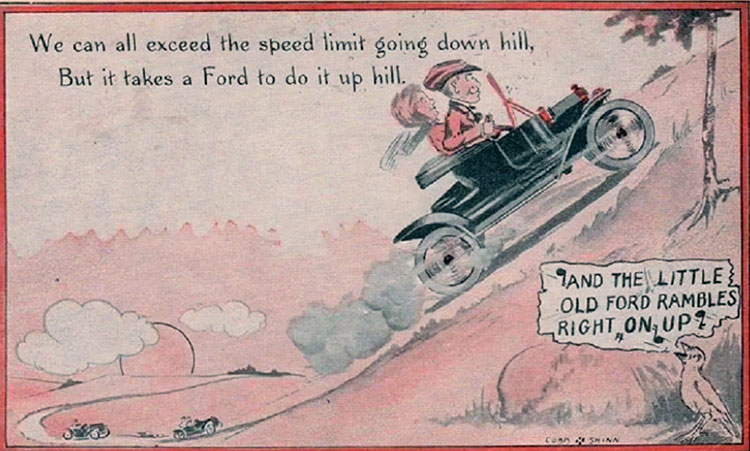
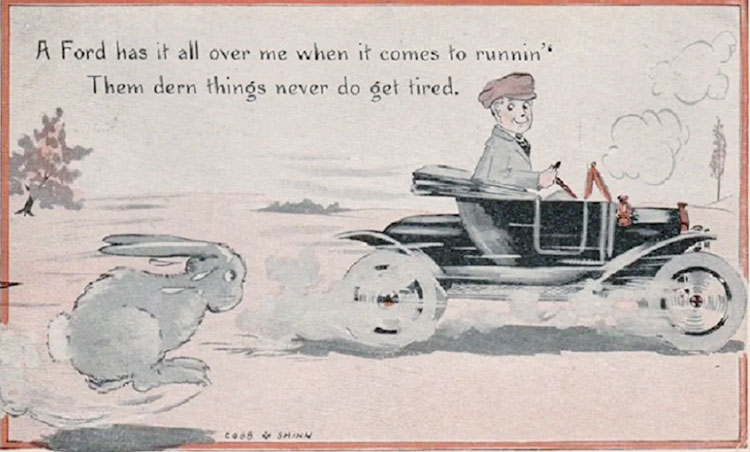
Ford Model T era cartoon about going up hills
DID FORD INVENT THE ASSMBLY LINE METHOD OF PRODUCTION?
No. Various industries used assembly line methods, especially the weapons industry. The first vehicle to be mass produced, the Curved Dash Oldsmobile, in 1903, used an early form of production line, where the workers did the same job on successive vehicles, which would be moved on rollers between build stations. Ford’s big contribution, beginning in 1913, was to create a moving track to move vehicles along, with different teams of people performing the same task again and again. There were multiple sub-assembly production lines which all fed into the main line where the cars were assembled. The first individual process they started with was building magnetos. One by one, time and motion experts created processes, breaking them down into individual steps and making sure there was a ready supply of identical parts on hand. The unprecedented demand for Ts allowed for the massive investment to make the system work and crank out Model Ts in staggering quantities.