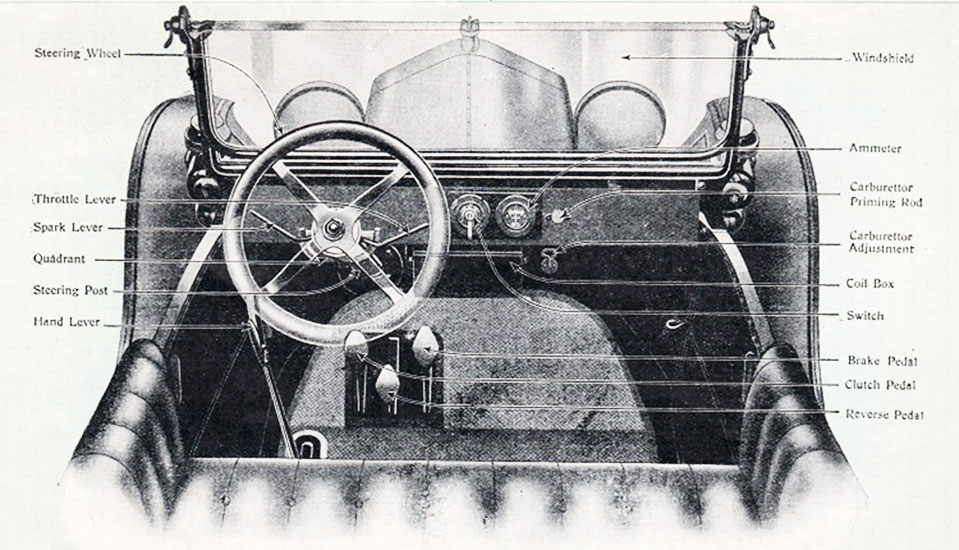
Ford Model T – Controls
Non-Starter Keys and hand crank
Model Ts require a key. Until mid-1923, when Ts had wooden firewalls, the key slot was on the outside of the trembler coil box. The key was large and irregular in shape, designed to fit into various holes before it could be turned. The key only completes the circuit between the magneto and the coils. You turn the key, set the spark and throttle levers, and then hand-crank the engine to get it started.
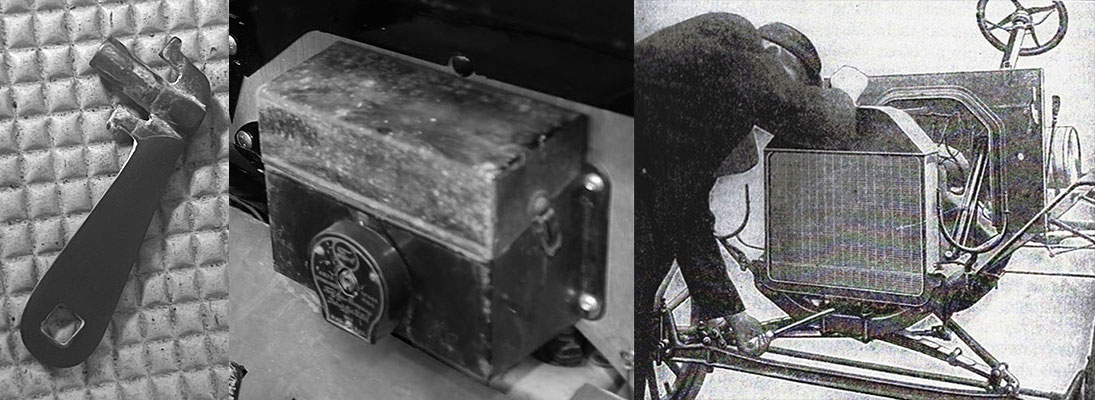
Ford Model T buzz box and hand crank
Electric Start Model Ts
Until 1923, the T continued to need the irregular key to be inserted into the tremble coil box. After 1923, the key was changed and the slot moved to the dashboard. In model years 1924 and 1925, this was housed inside a plain rectangle that also housed the light switch and an amp meter. In 1926 it was given a rounded design. In all instances, the key is turned to the battery position (at the 10 PM position) which completes the circuit to the coils, and then the driver presses down on a button on the floor with his heel to engage the starter motor. Once the car is running, the driver has to turn the key to the 2 o’clock position, which engages the magneto circuit. This has to be done quickly to avoid stalling the engine in the moment in between battery and magneto.
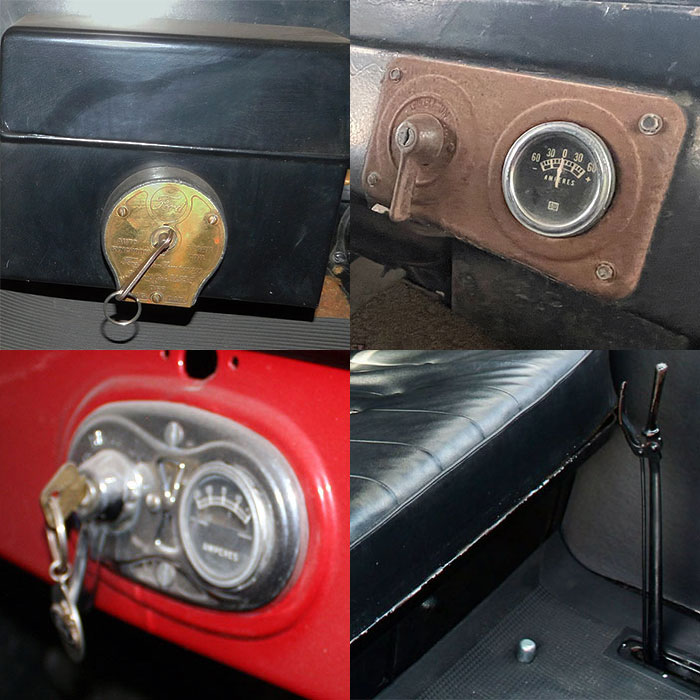
Ford Model T starter keys and button
Head lamp switch
Once Ts were fitted with head and rear lamps powered by electricity in 1915 – magneto powered lights to be specific – the switch was a modified horn button on the steering column. The driver twisted the knob for the off, dim and bright positions. After 1919, the switch was moved to the dashboard. The driver simply engaged a lever switch that surrounded the ignition key slot. There were three positions – off, dim and bright. Prior to this, Ts had acetylene and kerosene powered lights.
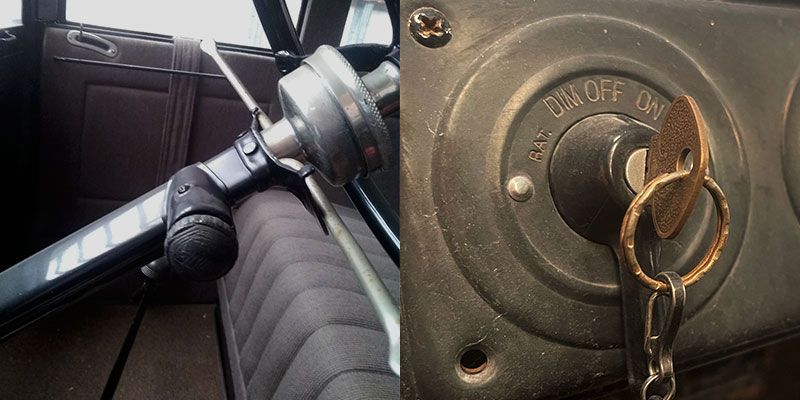
Ford Model T headlight switches
Spark and Throttle Levers
The speed is regulated with the lever on the right side of the steering column. There is no gas pedal. The lever does not return to idle. It stays where it is placed, acting like a kind of cruise control.
Setting the engine timing – which is making sure the spark plugs fire at the optimal point during the engine’s four stroke cycle – is controlled by the lever on the left side of the steering column. In a nutshell, you retard the spark – set the lever towards the top – when starting the car, as this helps it catch and start running. Once running, the lever should be moved to more or less the 7 PM position. The exact spot is a matter of experience. Drivers will learn to put it where the engine sounds and feels the best. While driving, minimal adjustments are sometimes needed, such as when the engine slows down going up hills. But most of the time, you simply set it and leave it alone. But each T is slightly different. Owners should learn what their T needs and do that.
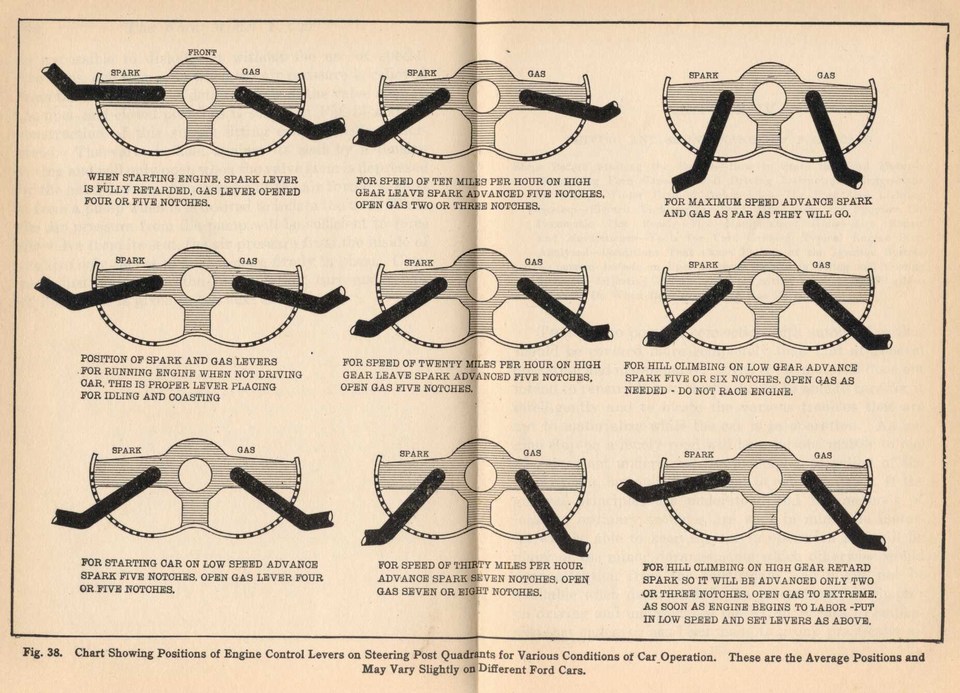
Ford Model T Spark and Throttle Lever Positions
Choke and fuel mixture control
The choke is controlled by a round control on the right side of the dashboard on left hand drive Ford Model Ts, You pull it out when starting a cold engine. This makes the fuel mixture a little richer – more fuel, less air. This helps to get the engine going, especially on the first start of the day. If the engine is warm, you may not need to use the choke at all. Releasing the choke returns the mixture to normal. Some Ts need the choke to be released quickly and others require a more gradual release. The rod is connected to the carburetor and closes the butterfly valve that controls the fuel/air mixture. If the engine will only run with the choke completely pulled out, you have a problem that needs fixing. The fuel/air mix may be set incorrectly, the fuel line may be partially blocked or the filter inside the tank may be clogged.
Depending on the year of your T, this same control may be turned to set the fuel/air mixture as you are going down the road. Some have a little raised tab so you can see how much it has been turned. On other Ts, the fuel/air mixture control is a separate lever, just under the dashboard, below the choke rod. Either way, turning it clockwise makes the mixture richer. Turning it anticlockwise makes it leaner. Most people set it for a smooth idle. (This can also be done directly at the carburetor.) Adjusting the mixture while going down the road should be considered fine tuning. Each T will let you know if you can set it and leave the mixture alone or if it requires some adjustments under different circumstances.
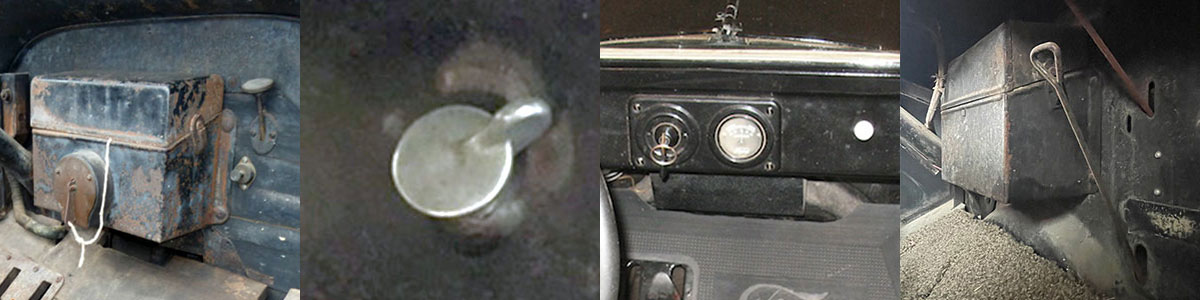
Ford Model T chole and fuel mixture locations
Pedals
The T has three pedals. The one on the left controls forward motion. Low gear is when it’s pressed to the floor. Neutral is the halfway point. Completely up is regular (high) gear. The middle pedal is for reverse. The pedal on the right is the brake pedal.
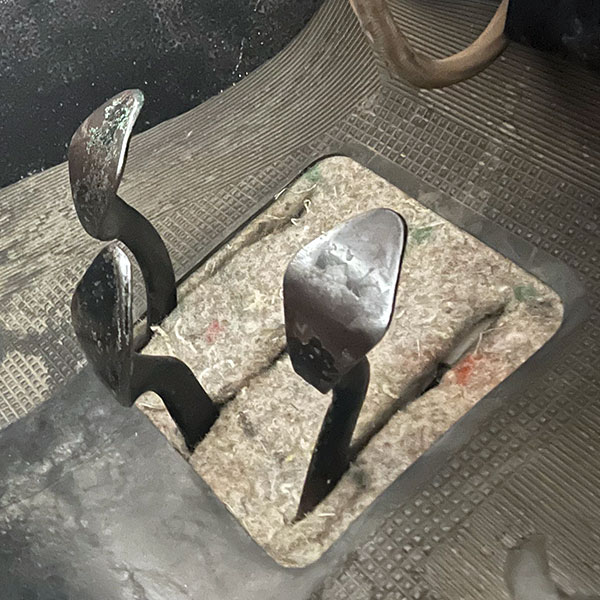
Ford Model T pedals
Security – Door handles and Locks
Making sure no one can take your T was taken care of mainly by after-market devices for the first few years of the T. These mainly stopped the steering wheel from being able to be moved.
Open Ts pretty much were insecure in terms of protecting anything you might decide to leave in the car. They did not have external door handles and only a small lever at the top of the doors on the inside, easily accessible since there were no windows. Enclosed cars had exterior handles and the doors could be locked.
People with runabouts with the turtle deck were issued what looked like a small house padlock key. The owner inserted and turned it, then pulled up on it. There was no other handle.
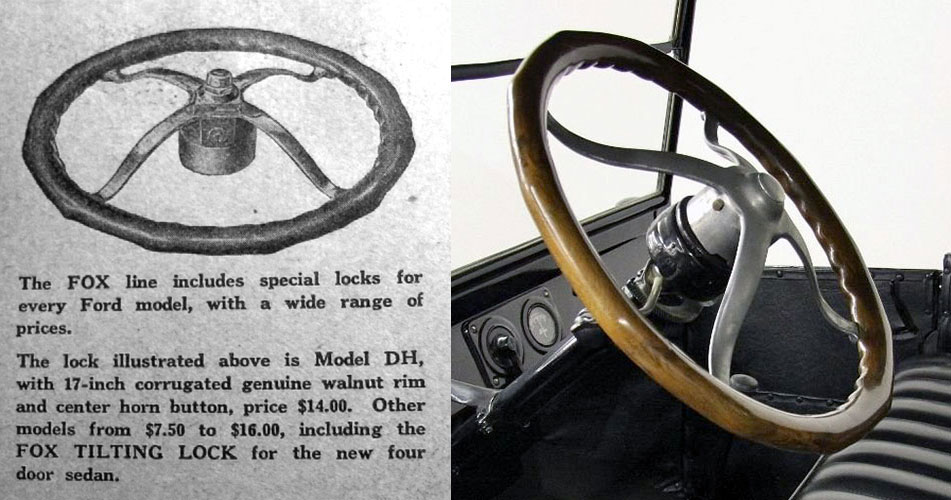
Ford Model T Locking steering wheels
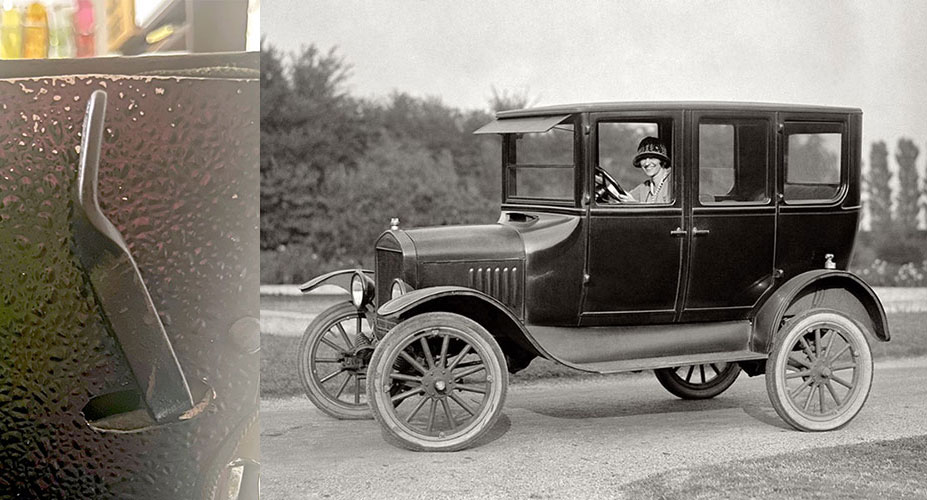
Ford Model T open and closed car door handles
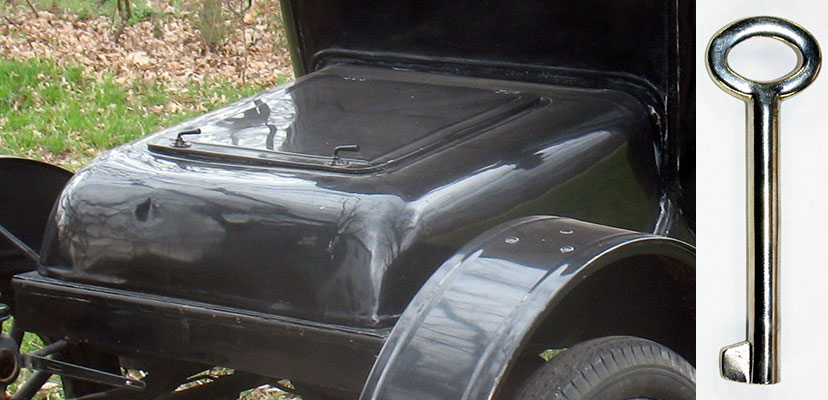
Ford Model T turtle deck and key